The global dropshipping market reached at least USD 365 billion in 2024 and is projected to grow to over USD 1.25 trillion by 2030, with a CAGR of about 22%. In Poland, e-commerce is expanding just as rapidly — valued at USD 24.8 billion in 2025 and forecasted to hit USD 37.4 billion by 2030 (CAGR approx. 8.6%).
Notably, the fashion sector — a key segment in influencer merchandise — accounts for over 34% of the global dropshipping market, reflecting growing demand for limited collections and creator-led product drops.
Today, an influencer with just tens of thousands of followers can launch their own merch without any warehouse infrastructure. With the support of an experienced fulfillment partner, they gain a real competitive edge. Fulfilio supports influencer brands such as Gałgan and 4444 Works, managing their drops end-to-end.
We spoke with Przemysław Sujak, Fulfilio’s Operations Manager, about how the company delivers high-performance drop logistics and what it takes to make each launch a success.
Why Is the Drop Model Winning in E-Commerce?
Drops — limited product releases sold within a short time frame — are now one of the hottest trends in e-commerce. Originating in streetwear, they’ve since become popular among content creators and microbrands across categories.
The key driver? Exclusivity. Scarcity fuels desire, triggering immediate purchasing action.
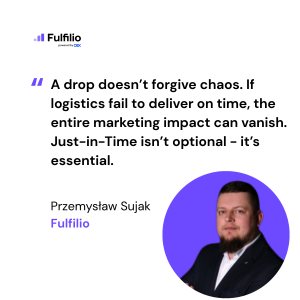
“For me, the most important thing is that a fan ordering a Gałgan hoodie gets it quickly and without a hitch. You can’t let the magic fade at the logistics stage,” says Sujak, who oversees drop operations for both Gałgan and 4444 Works.
The Logistics Challenges of Drop Models — Examples and Best Practices
While drops are exciting for customers and effective for marketing, they present high-stakes operational challenges where mistakes are costly. Drop logistics requires meticulous planning paired with extreme operational agility.
Here are two key areas that make or break a drop, along with market-proven best practices:
1. Pre-Sale & Time Pressure
In most drops, the bulk of orders is placed before the physical goods even arrive at the warehouse. From the moment of delivery, the fulfillment team has just 24–48 hours to pack and ship potentially thousands of orders. If operations aren’t ready the moment stock arrives, it can trigger a chain reaction of delays and customer frustration — or even a PR crisis.
Best practices:
Pre-pack and automated packing lines — Brands like Supreme and Adidas preconfigure packing stations before goods arrive. On delivery day, it’s simply “switch on and go.”
Supplier & carrier time-slot management — Companies such as Zalando and ASOS implement strict delivery slots to prevent bottlenecks at inbound docks.
Drop Day Task Force — Some e-commerce players form cross-functional “crisis teams” dedicated solely to drop-day execution and live problem-solving.
2. Zero Tolerance for Errors
In drops, “almost perfect” isn’t good enough. Customers who’ve waited in online queues or competed for a limited item expect flawless execution — fast delivery, pristine packaging, and impeccable service. One slip-up can quickly go viral for all the wrong reasons.
Best practices:
Double Check QC — Premium streetwear brands like Off-White and Palace run two quality control checks: once during kitting and again right before shipping.
Unboxing as a brand experience — Companies like Apple and Glossier invest in packaging that’s not just protective but visually engaging, often including personalized touches like hand-signed thank-you notes.
Real-time WMS validation — Advanced warehouse management systems (e.g., Manhattan Associates) validate order accuracy live, catching errors before parcels reach carriers.
“We know exactly when the delivery will arrive and how many units we’ll sell. The problem starts if logistics isn’t ready. It can’t be 95% right — it has to be 100%,” Sujak emphasizes.
Drop-Day Logistics Checklist
1. Warehouse Prep (D-1)
Dedicated packing zones set up for the drop.
Confirmed delivery time slots.
Drop-Day Task Force roster ready (shift leads, emergency contacts).
Packaging materials stocked (boxes, tape, fillers).
WMS tested for peak load handling.
Dry-run of the drop process completed.
2. Receiving Delivery (Drop Day – Morning)
Carrier confirms delivery time.
Priority docking & unloading.
Immediate quantity & quality checks.
Direct allocation to kitting areas (no general storage).
3. Picking & Packing (Drop Day – Midday)
Double Check QC active.
Real-time WMS validation.
Order personalization (cards, fillers, branded packaging).
Priority labeling for premium shipping tiers.
Live KPI monitoring of packing speed.
4. Handover to Carriers (Drop Day – Afternoon)
Coordinated pickup time slots.
Verified load lists.
Photo documentation of VIP shipments.
Customer notifications with tracking links.
5. Monitoring & Rapid Response (Drop Day – Evening)
Task Force tracks social media for feedback.
Dedicated hotline/chat for delivery issues.
WMS logs reviewed for discrepancies.
6. Post-Drop Review (D+1)
On-time fulfillment rate & error analysis.
Team feedback collection.
Lessons learned documented for next drop.
How Fulfilio Runs Drop Logistics
Just-in-Time Planning
Fulfilio schedules every operational step around the exact delivery hour. This ensures:
Warehouse is fully prepped.
Teams are ready for immediate order processing.
Parcels reach carriers the same day.
Flexibility for Creative Brands
Fulfilio has handled drops for Gałgan (two campaigns of 300 orders each) and 4444 Works (up to 1,000 parcels in a single drop).
Example actions:
Custom-sized cartons ordered for specific products.
Branded tape and premium internal packaging.
Adjustments based on customer feedback — from filler materials to box styles.
“We don’t have fixed requirements. Sometimes we just need sturdy packaging; other times, we want high-fashion presentation. Fulfilio adapts to each drop, and that’s a huge relief,” says Sujak.
5 Tips for Brands Planning Their First Drop
Start with a detailed timeline — lock in delivery dates and plan logistics weeks in advance.
Invest in premium packaging — branded boxes and tape elevate the customer experience.
Prepare for volume spikes — even a small audience can mean 300+ parcels in 24 hours.
Stay flexible — work with a partner who can improvise without losing control.
Act on feedback — every customer comment is an opportunity to improve the next drop.
Drops Are the Future of E-Commerce
In the era of social commerce, even creators with just 30,000 Instagram followers can sell merch like a pro — as long as they have the right logistics partner.
“Today, an influencer with 30,000 followers on Instagram can run their own merch without a warehouse. All they need is a partner who delivers,” Sujak concludes.
Why Fulfilio?
100% on-time performance — logistics aligned with drop schedules.
Flexibility — tailored packaging and processes.
Speed — 24–48 hour shipping.
Optimization — continuous improvement after each drop.
Want your next drop to be a logistics success?
Get in touch with Fulfilio — let’s talk.